

A cable machine earns its keep differently from a rack, bench or bike. It covers presses, rows, flyes, pulldowns, curls, triceps work and core training in one footprint, which is exactly why so many people start searching for the best compact cable machines once they realise space is the real limit in a home gym, not motivation.
The catch is that compact means different things depending on your room. In a spare bedroom, it might mean wall-mounted. In a garage gym, it might mean a narrow functional trainer that still allows full movement. In a garden room, it could mean a folding or corner-friendly design that keeps the floor usable. The right choice is less about chasing the smallest frame and more about finding the machine that gives you enough exercise variety without making the room feel crowded.
What makes the best compact cable machines worth buying?
A good compact cable machine should solve a space problem without creating three more. That means it needs to fit your ceiling height, leave enough room to stand and move, and offer a resistance path that feels smooth rather than jerky. If the pulleys are rough, the adjustment points are awkward, or the machine wobbles under load, the compact footprint stops feeling like an advantage very quickly.
For most home users, the best models balance four things well: sensible dimensions, enough resistance for progressive training, reliable build quality, and exercise versatility. You do not need a commercial-sized unit to get strong at home, but you do need a machine that will still feel useful six months from now, not just on week one.
It also helps to be honest about how you train. If your sessions lean heavily on bodybuilding-style accessories, a dual-pulley functional trainer usually makes more sense. If you want one cable station to add rows, lat work and rehab-friendly movements around your main free-weight setup, a single-column or wall-mounted unit can be the smarter buy.
7 best compact cable machines to consider
1. Wall-mounted cable machines
For very tight spaces, wall-mounted units are often the most practical answer. They keep depth low, free up walking space, and suit spare rooms where every centimetre matters. They are especially useful if your home gym already includes a bench, adjustable dumbbells or a barbell setup and you simply want cable work without bringing in another large frame.
The trade-off is stability and exercise range. A well-made wall-mounted machine can feel excellent, but installation matters, and not every wall is suitable without reinforcement. You also need to think carefully about fixing height and your available training angle.
2. Single-stack functional trainers
A single-stack functional trainer is a strong middle ground for many UK homes. It gives you adjustable pulley positions and a neater footprint than larger dual-stack machines, while still covering an impressive amount of upper-body and core work. If you value tidy design and want one self-contained station, this format is hard to ignore.
Where it can fall short is bilateral training. You can still do plenty, but if you want true dual-cable flyes, independent arm work and a more commercial-gym feel, you may find it limiting over time.
3. Narrow dual-pulley machines
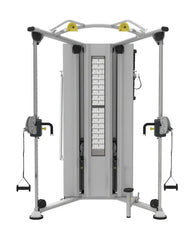
When people picture the best compact cable machines, this is usually what they have in mind: a slim functional trainer with two adjustable pulleys and a weight stack or plate-loaded system. For serious home gym users, it offers the broadest exercise menu in a relatively sensible footprint.
This is often the sweet spot if you want a machine to become a central part of your training rather than a useful extra. The main consideration is width. A machine may be labelled compact, but if it dominates the room or blocks storage access, it is not compact in any practical sense. The Perform Series Dual Adjustable Pulley is a good example done well, with a 2:1 pulley ratio for smooth resistance and a working footprint of roughly 1.5m x 2m.
4. Plate-loaded cable stations
Plate-loaded machines appeal to buyers who already own Olympic plates and want to keep costs down without stepping into flimsy kit. They can offer excellent value and, in some designs, a smaller footprint than selectorised stack models. For a home setup where budget and flexibility both matter, this category deserves attention.
The compromise is convenience. Loading and unloading plates is slower than moving a pin, which is fine if you train methodically but less appealing if multiple people use the gym or you like rapid supersets.
5. Folding cable machines
A folding design suits multi-use rooms where the gym has to share space with work, storage or everyday living. When folded away, these machines can make a compact home setup feel much more manageable, especially if you are training in a converted room rather than a dedicated outbuilding.
You will want to check the setup process before buying. A machine that folds neatly but is awkward to deploy can become something you use less often than expected. Compact only works if it is convenient day to day.
6. Corner cable machines
Corners are often wasted in home gyms, which is why corner-friendly cable designs can be so effective. They use awkward dead space well and can open up the centre of the room for a bench, mat or free weights. In square rooms, that layout benefit can matter more than a few centimetres on the spec sheet.
The trade-off is placement flexibility. Once it is in the corner, that is usually where it stays, so it needs to suit your room properly from the start.
7. Cable machines integrated with power racks
If you are building a more complete training setup, a rack with an integrated cable system can be one of the smartest long-term choices. It combines two major stations into one footprint and makes sense for users who already know they want to squat, press, pull and do accessory work at home.
The downside is that it is only compact relative to buying separate units. For smaller rooms, an integrated setup can still be too much. But in a garage or larger dedicated gym, it can be the most efficient use of space and budget.
How to choose the best compact cable machines for your space
Start with the room, not the product. Measure ceiling height, wall clearance, usable floor space and door access. Then measure the area you still need around the machine once it is installed. This is where buyers often get caught out. A machine might technically fit, but if you cannot perform flyes, lunges, rows or overhead work comfortably, the footprint has been judged too narrowly.
Next, think about resistance style. Selectorised stacks are cleaner and quicker to use. Plate-loaded machines can offer better value if you already own plates. Neither is automatically better. It depends on whether convenience or cost efficiency matters more in your setup.
Pulley ratio matters too, especially if you are comparing machines with very different listed weights. A 90 kg stack does not always feel like 90 kg in hand, because pulley systems change the effective resistance. For many users, that is not a problem at all, but it is worth understanding if you train heavier or want room to progress.
Build quality should sit near the top of the list. Look for smooth pulley travel, solid adjustment mechanisms, sensible handle storage, and a frame that feels planted under load. In a home environment, noise can matter as much as raw strength capacity, particularly if you train early, late, or in a shared house.
Common mistakes when buying compact cable equipment
The biggest mistake is buying on dimensions alone. Small does not automatically mean practical. A poorly designed machine with awkward cable travel or limited adjustment can be more frustrating than a slightly larger one that works properly.
Another common issue is ignoring setup requirements. Wall-mounted systems may need proper fixing. Larger units may arrive in heavy boxes that are difficult to move upstairs or through narrow hallways. Delivery is only the first stage. Assembly and final positioning matter just as much.
Some buyers also underestimate how quickly training needs change. A machine chosen purely for rehab, light toning or occasional accessory work can start to feel restrictive once consistency builds. If you believe your training will become more serious, buying a little more machine than you currently need is often the better long-term decision.
Which type suits most home gyms?
For most people, a narrow dual-pulley machine or a well-designed single-stack functional trainer offers the best balance of size and capability. They cover the widest range of exercises, suit beginners and experienced users alike, and feel like a meaningful upgrade rather than a compromise.
That said, there is no single winner for every room. A renter may prefer a freestanding unit over wall-mounted equipment. A serious lifter with a garage setup may get better value from a rack-and-cable combination. Someone fitting out a box room may find a slim wall-mounted machine is the only sensible option. The best compact cable machines are the ones that match your actual training space, not just your wish list.
If you are buying for a home gym, think beyond first impressions. Good equipment should feel easy to live with, easy to progress with, and solid enough that you are not revisiting the same purchase a year later. Choose once, train for years.
Frequently asked questions
What is the best compact cable machine for a home gym?
For most home users, a narrow dual-pulley compact cable machine like the Perform Series Dual Adjustable Pulley offers the best balance of exercise variety and footprint. Wall-mounted options suit tighter spaces, while rack-integrated systems suit buyers who already want a power rack.
Is a compact cable machine as effective as a full-size cable station?
Yes, for the vast majority of home training. A well-built compact cable machine covers presses, rows, pulldowns, flyes and core work just as effectively as a larger commercial unit — you are trading some bilateral, dual-cable exercises for a footprint that actually fits a home gym.
How much space does a compact cable machine need?
Most compact cable machines need a working footprint of around 1.5m x 2m once you allow for stepping on and off and full range of motion, though wall-mounted units can need less depth. Always measure your ceiling height too, since that catches out more buyers than floor space does.
Ready to set your machine up properly? See our guide on home cable machine setup.


