

A spare room can look generous until a treadmill arrives, a bench needs moving room, and the door only opens halfway. Knowing how to measure gym space properly means planning for the equipment, the exercise you will do around it, and the route it must take to get there. A few careful measurements now can prevent an awkward layout, damaged walls and an expensive return.
The aim is not to fill every available inch. A good home gym feels usable on a tired Tuesday evening as well as on day one: safe to move in, quick to set up and easy to keep tidy.
How to measure gym space accurately
Start with the room itself, measuring its internal length, width and ceiling height in centimetres. Measure at floor level rather than relying on estate-agent dimensions or a rough estimate. Period homes, loft rooms and converted garages are rarely perfectly square, so take measurements at more than one point if a wall tapers or an alcove is involved.
Write the dimensions as length x width x height. For example, a room measuring 3.2m x 2.7m with a 2.35m ceiling gives you a clear starting point. Then mark anything that reduces the usable area: radiators, window ledges, built-in cupboards, sloping ceilings, sockets, light switches and door swings.
A simple floor plan on squared paper is usually enough. Use a scale that is easy to work with, such as 1cm to 20cm, and add the position of doors and windows. If you prefer, use masking tape on the floor to map out larger items at their real footprint. This is particularly useful when deciding whether a rack, reformer or treadmill will dominate the room.
Do not measure only the area where equipment will sit. Measure the full clear zone needed to use it. A bench may have a compact base, for instance, but you need room to lie down, load a bar and step safely around either side.
Separate equipment size from training space
Every product has an equipment footprint, but that is only one number to consider. The operational footprint includes the space required while it is in use. A rowing machine extends as you slide backwards; an adjustable bench takes more room when set at an incline; a cable machine may require space for the user and attachments.
As a practical rule, leave at least 60cm of clear walking space on the main route through a home gym. For active exercise zones, allow more. You need room to step back from a squat rack, change plates, get on and off cardio equipment, and recover safely if you lose balance.
Manufacturer dimensions and safety clearances should always take priority, especially for powered cardio machines. Treadmills commonly need clear space behind the deck in case a user steps off unexpectedly. Cross trainers and exercise bikes need enough clearance for pedals, handles and safe entry. Never place a powered machine where its movement or emergency stop access is restricted.
Plan around the way you train
The right amount of gym space depends less on the room’s headline size and more on your training. A compact strength setup can work brilliantly in a box room when it is chosen with care. A dedicated Pilates or yoga area benefits from open, uninterrupted floor space even if it contains less equipment.
For strength training, begin with the movements you use most often. If you squat, press and bench with a barbell, map the rack, bench and bar before adding smaller items. Remember that a standard Olympic barbell is usually 2.2m long. Even a shorter bar needs room at both ends for loading plates and moving safely around the setup.
If your priority is dumbbell training, a bench, adjustable dumbbells or a compact storage rack may offer more flexibility than a full rack. The trade-off is that you still need an open area for lunges, floor work and pressing. Storage should sit close enough to be convenient without narrowing the route through the room.
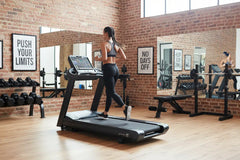
Cardio equipment deserves its own zone. Positioning it facing a window can make regular sessions more enjoyable, but do not block ventilation, curtains or access to the window. Consider where power sockets are located before choosing a treadmill or other mains-powered machine. Extension leads across a floor are a trip hazard and are best avoided.
For yoga, measure the practice area rather than only the mat. A standard yoga mat is commonly around 173-183cm long and 61cm wide, but a comfortable home practice needs clearance around the edges for wide-legged standing poses, arms overhead and transitions on the floor. If two people will practise together, test the layout with two mats and a clear gap between them.
Pilates needs similar thought. A mat-based setup may require little more than open floor space and a storage basket for rings, blocks and bands. A reformer has a much larger footprint, however, and needs room at either end for safe mounting, adjustment and movement. Check both the machine dimensions and the manufacturer’s recommended clearance before committing.
Check height, floor and access before ordering
Floor area is only part of the calculation. Ceiling height matters whenever you press weights overhead, use a pull-up bar, jump, or train with a tall frame. Measure from the finished floor surface, not from the subfloor. Thick rubber flooring, interlocking tiles or a lifting platform can take several centimetres from your available height.
For overhead work, stand in the planned position with your arms fully extended and allow additional room for the equipment. If your ceiling is low, seated presses, landmine work, dumbbells and resistance bands can be sensible alternatives to forcing a barbell movement into a restricted space.
Your floor needs consideration too. Most domestic ground floors can accommodate home fitness equipment, but heavy racks, loaded barbells and cardio machines create concentrated loads and vibration. Flats, upper-storey rooms and older properties call for extra care. Distribute weight where possible, use suitable gym flooring, and seek professional advice if you are unsure about the structure.
Rubber flooring can protect the surface beneath equipment, reduce noise and give better grip. It does not make unsafe lifting or an overloaded upper floor safe, but it is a worthwhile part of a well-planned setup. Measure its coverage area with a little allowance for edges and cuts around door frames.
Finally, measure the delivery route. Check the narrowest point from the entrance to the training room, including gates, hallways, stair turns, door frames and low ceilings. A large item may fit the room but not the staircase. Compare these measurements with the packaged dimensions as well as the assembled product dimensions, because packaging can be wider or taller than the item itself.
Make a layout that can adapt
Most home gyms work better when they are organised in zones rather than arranged like a commercial gym. Keep the primary training area open, place heavy equipment against suitable walls where appropriate, and use vertical storage for plates, dumbbells, mats and accessories. This makes cleaning easier and stops smaller kit spreading into your workout space.
Before buying, check these four measurements against each item’s specification:
- The equipment footprint when stored or folded
- The operational footprint when you are using it
- The ceiling height required for your movements
- The narrowest delivery and access point in your home
Think about what changes over the next year, too. A foldable bench or adjustable dumbbells can be a strong choice in a multi-use room, while a fixed rack may be the better long-term investment if training is a firm priority. There is no universal best layout. The right answer depends on whether you need a quiet early-morning cardio corner, a serious strength station, or a calm space that is ready for Pilates and yoga without a lengthy set-up.
Leave a little room for the way you actually live. When the kit fits well, has a place to go and does not turn every session into furniture-moving, it is far more likely to earn its keep.


